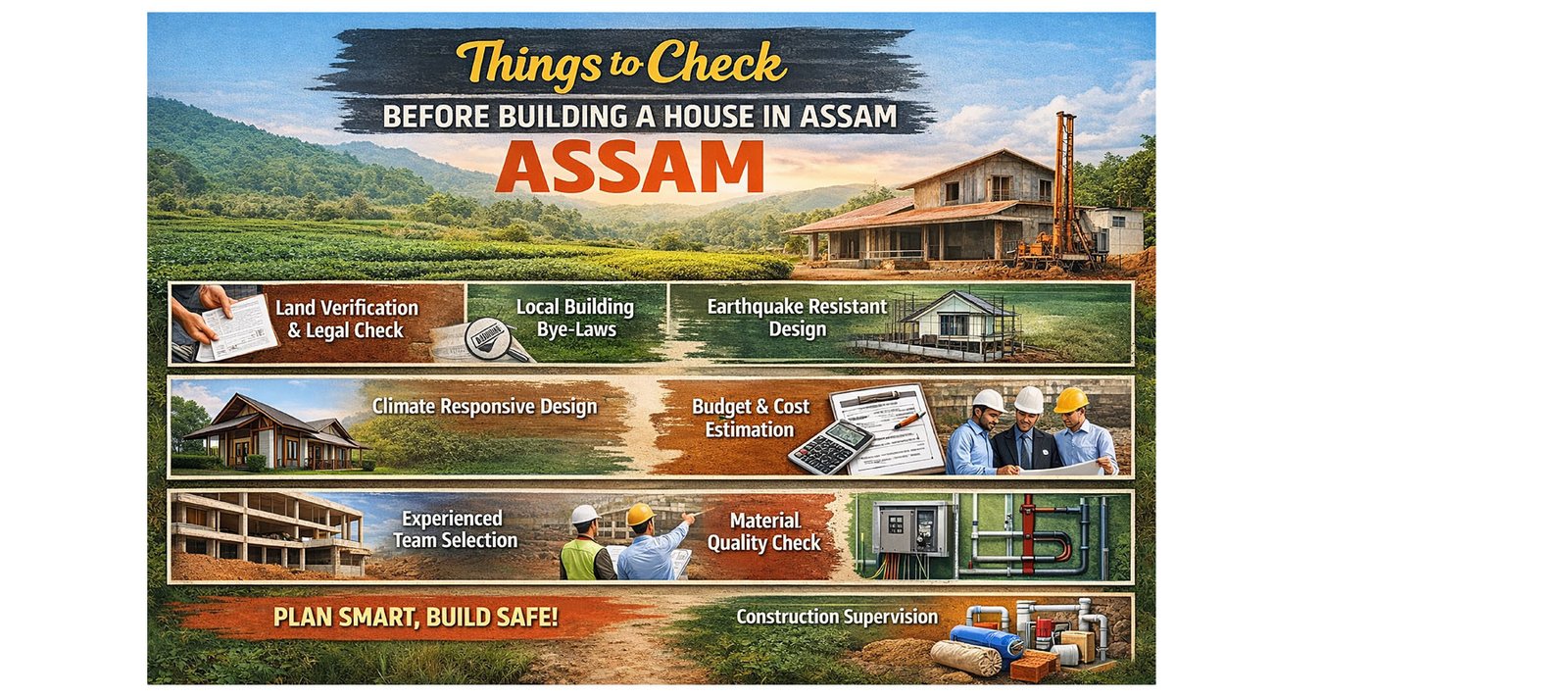
Things to check before building a house in Assam
1. Land Verification and Legal Clearance
Before any design or excavation begins, confirm that the plot is legally and technically suitable for construction.
Key checks:
-
Clear land title with updated Jamabandi / Patta
-
Proper land classification (not agricultural or restricted)
-
Accurate plot boundaries and dimensions
-
Road access and right-of-way
-
Flood-prone or low-lying land identification
Expert tip: Always cross-check site measurements physically instead of relying only on sale documents.
2. Soil Testing—Non-Negotiable in Assam
Assam has varied soil strata, including clayey and loose soil, particularly near rivers and wetlands. Designing foundations without soil investigation is risky.
Why soil testing matters:
-
Determines safe bearing capacity of Soil (SBC)
-
Helps decide foundation depth and type
-
Prevents uneven settlement and cracks
-
Optimizes structural cost
Skipping this step often leads to overdesigned or unsafe foundations.
3. Local Building Bye-Laws and Permission Drawings
Every municipal and town area in Assam follows Assam Unified Building Byelaws, 2022 | Housing & Urban Affairs
Verify the following:
-
Plot coverage and FAR limits
-
Setbacks from boundaries and roads
-
Height restrictions
-
Parking norms
-
Drainage and rainwater provisions
Construction without approved drawings can result in penalties or demolition notices later.
4. Earthquake-Resistant Structural Design
Assam falls under Seismic Zone VI, the highest risk category in India.
Structural safety essentials:
-
RCC framing designed by a qualified Structural Engineer
-
Proper column–beam layout
-
Earthquake-resistant detailing as per IS codes
-
Controlled cantilever lengths
-
Avoiding irregular floor plans
Structural design must never be handled by draftsmen or site contractors.
5. Climate-Responsive Architectural Planning
Assam’s climate includes heavy monsoon rainfall, high humidity, and warm summers.
Good design should consider:
-
Proper roof slope and drainage
-
Cross ventilation
-
Sun-path orientation
-
Shaded openings and verandahs
-
Damp-proofing and waterproofing strategy
Climate-sensitive planning reduces long-term maintenance and improves indoor comfort.
6. Budget Planning and Cost Estimation
Many homeowners underestimate construction costs and face financial stress mid-project.
Before starting, prepare:
-
Detailed BOQ and material specifications
-
Construction cost per square foot (realistic, not advertised rates)
-
Separate provision for contingencies
-
Clear payment milestones
Transparent estimates help you control quality and cash flow.
7. Selection of the Right Design & Construction Team
A house is not just built; it is engineered, planned, and coordinated.
Ideal team structure:
-
Architect for planning and aesthetics
-
Structural Engineer for safety
-
Civil Engineer for execution control
-
Interior planning at early design stage
Avoid assigning complete responsibility to one person without professional specialization.
8. Material Selection Based on Local Conditions
Assam’s climate directly affects material performance.
Materials need to be:
-
Moisture-resistant
-
Termite-safe
-
Durable in humid conditions
-
Easily serviceable locally
Wrong material choices lead to faster deterioration and frequent repairs.
9. Construction Supervision and Quality Control
Even the best drawings fail without proper execution.
Must-have checks:
-
Reinforcement before concreting
-
Concrete mix control
-
Curing duration
-
Level and alignment checks
-
Stage-wise inspection reports
Site supervision protects your investment far more than cost cutting.
10. Utility Planning Before Construction
Late planning of services causes rework and damage.
Plan early for:
-
Electrical load and inverter provision
-
Plumbing shaft locations
-
Septic tank or sewer connection
-
Rainwater harvesting
-
External drainage slope
Service planning should be part of the initial design, not an afterthought.
Final Thoughts
Building a house in Assam requires technical understanding, regulatory awareness, and professional coordination. Most construction failures happen due to poor planning, not poor intention.
By checking these ten critical points before construction, you protect:
-
Structural safety
-
Legal compliance
-
Budget control
-
Long-term durability
A well-planned house is easier to build, easier to maintain, and safer for your family.