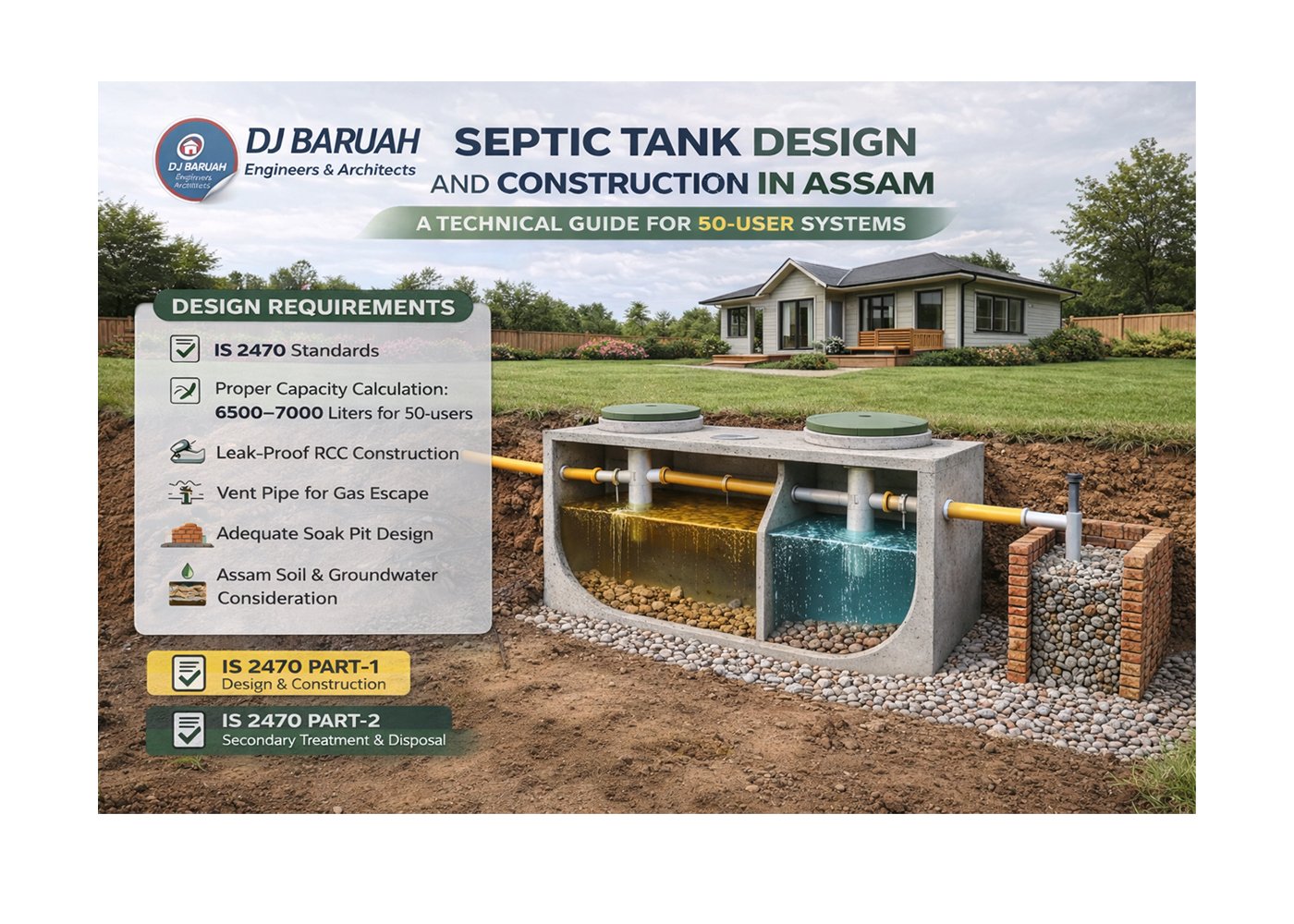
Septic Tank Design and Construction in Assam: A Technical Guide for Residential and Commercial Buildings
Proper septic tank planning is a critical part of building construction in Assam. Whether you are constructing a residential house in Jorhat or developing a commercial building in Upper Assam, wastewater management must be handled carefully.
Due to high rainfall, varying soil conditions, and fluctuating groundwater levels in Assam, septic tank design requires technical precision. Improper construction can lead to contamination, structural failure, foul odor, and environmental issues.
This guide explains septic tank design standards, calculation methods, structural requirements, and Assam-specific considerations from an architectural and engineering perspective.
Why Septic Tank Design is Critical in Assam
In many parts of Jorhat, Golaghat, Sivasagar, and Dibrugarh, centralized sewer systems are not available. Therefore, most residential and semi-commercial buildings depend on septic tanks for wastewater treatment.
Key regional factors include:
-
Heavy monsoon rainfall
-
High groundwater table in low-lying areas
-
Clayey and silty soil conditions
-
Flood-prone zones
-
Borewell proximity risks
These factors make standard septic tank design insufficient. Structural and environmental considerations must be integrated during architectural planning.
Relevant IS Codes for Septic Tank Design
Septic tank construction in India is governed by:
IS 2470 (Part 1): Design and Construction
IS 2470 (Part 2): Secondary Treatment and Disposal
These codes specify:
-
Minimum detention period
-
Sludge storage requirements
-
Tank dimensions and proportions
-
Vent pipe installation
-
Inlet and outlet pipe levels
-
Soak pit design parameters
Any septic tank design in Assam should align with these standards to ensure safety and compliance.
Septic Tank Capacity Calculation
Correct sizing is the most important step in septic tank planning.
Step 1: Determine Sewage Generation
As per CPHEEO guidelines, average domestic sewage generation is approximately:
135 liters per capita per day (LPCD)
For example:
For 50 users:
50 × 135 = 6,750 liters per day
Step 2: Detention Time
IS standards recommend a minimum 24-hour retention period.
Therefore, base tank capacity = 6.75 cubic meters (approx.)
Step 3: Sludge Storage Volume
Sludge accumulation must be considered for at least one year of storage.
Typically, an additional 30–50% volume is added.
Final recommended capacity for 50 users:
9 to 10 cubic meters minimum
This may vary based on usage type (residential vs commercial).
Recommended Dimensions for 50-User System (Indicative)
For a 9–10 m³ septic tank:
-
Length: 4.5 – 5.0 meters
-
Width: 1.5 – 1.8 meters
-
Liquid depth: 1.2 – 1.5 meters
-
Freeboard: 300 mm
Two-compartment configuration is mandatory:
-
First chamber: 2/3 volume
-
Second chamber: 1/3 volume
Proper partition wall and baffle arrangement is required to prevent sludge transfer.
Structural Design Considerations in Assam
Because of groundwater pressure and soil conditions, septic tanks must be structurally sound.
Concrete Grade
-
Minimum M20 grade recommended
-
In high water table areas, M25 may be preferable
Reinforcement
-
Designed to resist lateral soil pressure
-
Designed to resist uplift pressure in flood-prone zones
Wall Thickness
-
150 mm to 230 mm depending on structural design
Waterproofing
-
Internal plaster with waterproof compound
-
External bituminous coating if groundwater level is high
Anti-Floating Measures
In areas like Jorhat with seasonal groundwater rise:
-
Provide raft base slab
-
Increase base thickness
-
Anchor tank properly
Failure to consider buoyancy can cause tank displacement.
Ventilation and Gas Management
A properly designed septic tank must include:
-
Vent pipe (minimum 50 mm diameter)
-
Height above roof level
-
Mosquito-proof cowl
Without ventilation, methane gas buildup can cause odor issues and structural stress.
Soak Pit Design in Assam
Septic tank alone does not complete wastewater treatment. Effluent disposal must be planned carefully.
Soak Pit Requirements
-
Located away from borewell
-
Minimum 15 meters distance from drinking water source
-
Designed based on soil percolation rate
In clay soil areas common in Assam, percolation may be slow. In such cases:
-
Larger soak pits
-
Multiple dispersion trenches
-
Elevated filtration beds
may be required.
Septic Tank Placement in Site Planning
During architectural planning in Jorhat and surrounding areas, septic tank placement must consider:
-
Distance from foundation
-
Distance from boundary wall
-
Distance from water source
-
Natural slope of site
-
Accessibility for desludging vehicle
Incorrect placement can create long-term structural and sanitation issues.
Common Septic Tank Construction Mistakes in Assam
Many on-site septic tanks fail because of poor planning.
Frequent mistakes include:
-
Undersized tank capacity
-
Single chamber construction
-
No proper partition wall
-
Inlet and outlet at same level
-
Absence of vent pipe
-
Poor RCC compaction
-
No waterproof treatment
-
Direct discharge into open drains
These errors can cause contamination of groundwater and foul odor problems.
Septic Tank Design for Residential vs Commercial Projects
Residential Houses in Jorhat
-
4–6 user systems
-
Smaller footprint
-
Focus on accessibility
Apartment Buildings
-
Larger user load
-
Higher sludge generation
-
Structural reinforcement critical
Commercial Buildings
-
Higher water usage
-
More frequent maintenance
-
Possible need for larger retention time
Each project requires custom calculation rather than generic sizing.
High Rainfall Considerations in Assam
Assam receives heavy rainfall during monsoon.
Important precautions include:
-
Elevated top slab
-
Proper stormwater diversion
-
Prevent rainwater entry
-
Avoid mixing surface water with sewage
Rainwater inflow increases load and reduces treatment efficiency.
Environmental and Health Implications
Improper septic tank design can lead to:
-
Groundwater contamination
-
Soil pollution
-
Mosquito breeding
-
Public health risks
Therefore, septic tank design should be integrated into overall building planning.
Integration with Architectural Planning
In professional building design practice, septic tank planning is done simultaneously with:
-
Foundation layout
-
Plumbing routing
-
Site grading
-
Borewell positioning
-
Structural design
Isolated septic tank construction without architectural coordination often results in rework and additional cost.
Why Technical Planning is Important for Buildings in Jorhat
Construction in Assam requires understanding of:
-
Local soil profile
-
Seasonal groundwater fluctuation
-
Flood vulnerability
-
Municipal regulations
Septic tank design is not merely a plumbing task. It is part of the structural and environmental planning of the building.
DJ Baruah Engineers & Architects, based in Jorhat, integrates:
-
Architectural planning
-
Structural engineering
-
Sanitation layout design
-
RCC detailing
-
Site planning
for residential and commercial projects across Upper Assam.
Maintenance Recommendations
Even a properly designed septic tank requires maintenance.
Recommended:
-
Desludging every 1–2 years
-
Regular inspection of vent pipe
-
Prevent disposal of solid waste into system
-
Avoid excessive detergent discharge
Maintenance planning should be considered during design stage by providing proper access covers.
Frequently Asked Questions
What is the minimum septic tank size for 50 users?
Approximately 9–10 cubic meters depending on usage and sludge storage requirements.
Is RCC septic tank better than brick septic tank?
RCC tanks are structurally stronger and more suitable for high groundwater conditions in Assam.
Can septic tanks be constructed in flood-prone areas?
Yes, but anti-floating structural design and proper waterproofing are necessary.
Is IS 2470 mandatory?
It is the recommended Indian Standard for septic tank design and construction.
How far should septic tank be from borewell?
Minimum 15 meters recommended to prevent contamination.
Conclusion
Septic tank design and construction in Assam require technical accuracy, structural planning, and environmental awareness. From residential houses in Jorhat to commercial buildings in Upper Assam, correct sizing, RCC detailing, and soil consideration are essential.
Proper integration of sanitation design within architectural planning ensures:
-
Structural safety
-
Long-term durability
-
Environmental protection
-
Cost efficiency
For building projects in Jorhat and nearby regions, septic tank design must be approached as a technical engineering component rather than an afterthought.